
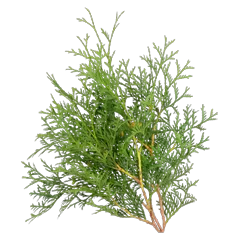
An evergreen conifer of the cypress family from North America, used in folk medicine and homeopathy mainly for warts and infections, and containing the toxic compound thujone.
What is this plant
Eastern arborvitae (Thuja occidentalis), also called "tree of life" (arborvitae) or northern white cedar, is an evergreen conifer of the cypress family (Cupressaceae). It is native to eastern North America, and today it is common as an ornamental tree in Europe and Brazil. The genus Thuja includes five species.
Parts used
- The leaves and young branches: for producing essential oil and tincture.
- The inner bark of young branches: as a decoction or infusion.
- Sometimes also the cones.
The main component of the essential oil is thujone (mainly alpha-thujone), along with fenchone, sabinene and alpha-pinene. The plant also contains flavonoids such as quercetin and kaempferol, coumarins, tannins and polysaccharides.
Traditional use
In folk medicine, thuja was used for fungal infections, intestinal worms, and as a tincture for warts and benign skin growths. Native American healers used it for constipation, headaches, wounds and pain relief. Other traditional uses include bronchitis, urinary tract infections, rheumatism and psoriasis. The tincture is also used in homeopathy.
What the research says
A comprehensive 2020 review describes antioxidant, anti-inflammatory, antibacterial, antifungal and antiviral activity, but most of the information comes from laboratory and animal studies, and it does not describe human clinical trials on the plant alone. Therefore, there is currently no research basis for proven therapeutic uses.
Safety and interactions
- Thujone is a toxic compound that may cause seizures at high doses, as demonstrated in animals and in case reports. The European Medicines Agency (EMA) has published guidance limiting the daily amount of thujone in herbal preparations, and thujone is regulated by the authorities in Europe.
- According to the EMA, there are no studies that allow the safety to be assessed in sensitive groups, so use is not recommended in pregnancy, breastfeeding or children.
- People prone to seizures or with epilepsy should avoid preparations containing thujone.
- Do not take the essential oil by mouth, and use only preparations with a defined dose and under the guidance of a practitioner.
Formulas with this plant