
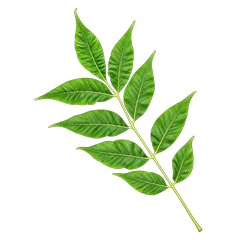
A tree of the rue family from East Asia whose yellow bark (huang bai) is one of the fundamental herbs of Chinese medicine and is rich in berberine.
What is this plant
Amur cork tree (Phellodendron amurense) is a deciduous tree of the rue family (Rutaceae), the citrus family. It is native to East Asia: northeastern China, Korea, Japan and the Russian Far East, and its name comes from the Amur River region. Mature trees have thick, corky, grayish-brown bark, beneath which is an inner layer of bright yellow. The leaves are pinnate and give off a citrus scent when crushed. The tree is dioecious, and the female trees bear small black fruits. In China it is listed as an endangered species.
Parts used
The dried trunk bark is used, known in Chinese medicine as huang bai (Phellodendri Cortex). It is obtained from two species, P. amurense and P. chinense. About 140 compounds have been identified in the bark, mainly alkaloids such as berberine, palmatine and phellodendrine, as well as limonoids, phenolic acids and flavonoids.
Traditional use
Huang bai is one of the fifty fundamental herbs of traditional Chinese medicine. It is described as bitter and cold, and is traditionally used to "clear heat", "dry dampness" and remove "toxins", as well as for sores. Historically it was also used in dysentery, cirrhosis and infectious conditions.
What the research says
A comprehensive 2019 review describes anti-inflammatory, antimicrobial, antioxidant and blood pressure lowering activity, but most of the evidence comes from laboratory and animal studies. The review did not find a body of human clinical trials supporting these uses. There is more research on isolated berberine, but there too there is a gap between preclinical findings and proven clinical efficacy.
Safety and interactions
- Pregnancy, childbirth and infants: The main concern is jaundice in newborns. In Singapore, the use of herbs containing this bark was banned as early as 1978, and its use is restricted around childbirth and in the newborn period.
- People with diseases involving the breakdown of red blood cells should be cautious and monitored.
- The bark may affect liver enzymes (CYP1A2 and CYP3A4) that metabolize medications, so it is important to consult a doctor or pharmacist when taking regular medications.
- The review concludes that the plant is generally safe, but extra caution is needed in sensitive groups.
Formulas with this plant