
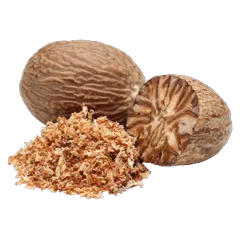
A tropical tree from Indonesia whose seed is the spice nutmeg, used in traditional medicine for digestion, pain and relaxation; at high doses it is toxic.
What is this plant
Nutmeg (Myristica fragrans) is an evergreen tree of the nutmeg family (Myristicaceae), native to Indonesia. Today it is also grown in India, Sri Lanka, Malaysia, China and South America, and Indonesia and Grenada are the main producers. The tree is dioecious, meaning there are male and female trees, and the female trees bear a fruit that splits open when ripe.
Parts used
- The seed: the grayish-brown nut from which the spice is produced.
- Mace: the red covering that surrounds the seed and is used as a separate spice.
The essential oil contains, among other things, myristicin, elemicin, safrole and sabinene. The composition of the oil differs between the seed and the covering: in the seed, myristicin and safrole stand out, and in the covering, sabinene stands out.
Traditional use
Nutmeg has a long history in traditional medicine, and the described uses include strengthening the stomach and improving digestion, relieving cramps and pain, as well as folk uses for balancing sugar.
What the research says
Recent reviews describe antioxidant, antimicrobial, anti-inflammatory and liver-protective activity, but the evidence comes almost entirely from laboratory and animal studies. The researchers stress that clinical research is needed to confirm the findings, and currently there are no controlled human trials that establish a therapeutic use.
Safety and interactions
In normal spice amounts in food, nutmeg is considered safe. However, in large amounts it is toxic:
- Poison control centers have reported hallucinations, drowsiness, dizziness, dry mouth, rapid heartbeat, confusion and, in isolated cases, seizures after swallowing large amounts. Symptoms may appear with as little as less than one tablespoon of powder.
- The effects are attributed mainly to myristicin and elemicin.
- In animal studies, high doses damaged the liver and kidneys.
- Reviews recommend limiting use beyond food amounts and note the possibility of drug interactions, for example an additive effect with sugar-lowering medications observed in mice.
- During pregnancy and breastfeeding, stick to spice amounts in food.
Formulas with this plant