
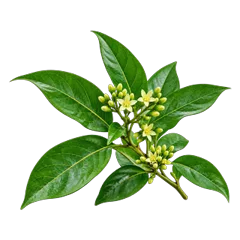
Gymnema is a climbing plant from India whose leaves are used in Ayurveda to support blood sugar balance and are known for their ability to dull the sensation of sweet taste.
What is the plant
Gymnema (Gymnema sylvestre) is a woody, branching climber in the dogbane family (Apocynaceae), growing in dry forests in central and southern India and in other regions of Asia, Africa and Australia. The plant has simple, opposite, ovate or elliptical leaves and small yellow flowers in umbels. The plant is classified as vulnerable, and overharvesting threatens it.
Plant parts used
In traditional medicine the roots, stems and leaves were used, but most research has been done on leaf extracts. The main active components are gymnemic acids, triterpene saponins.
Traditional use
In Ayurveda, gymnema is used for diabetes, and it is included in the Indian Pharmacopoeia as an antidiabetic plant. Other traditional uses include indigestion, constipation, jaundice, hemorrhoids and asthma. Chewing the leaves dulls the sensation of sweetness, a property attributed to the gymnemic acids and the peptide gurmarin.
What the research says
According to a 2019 review (Frontiers in Pharmacology), laboratory and animal studies have shown blood sugar lowering. A few small clinical trials in people with type 2 and type 1 diabetes reported a decrease in fasting and post-meal blood sugar and a decrease in HbA1c, but they are few in number, small, and most have methodological limitations. A 2021 meta-analysis that included ten studies with 419 participants with type 2 diabetes reported a decrease in fasting blood sugar, post-meal blood sugar, HbA1c and blood lipids, but the comparison was made against baseline values and not against a control group, and the variability between the studies was very high, so the evidence is weak. A mechanism of blocking sugar absorption in the gut is still a hypothesis.
Safety and interactions
- Gymnema may cause low blood sugar (hypoglycemia). Combining it with diabetes medications or replacing them with it without medical supervision may be dangerous, as the European Food Safety Authority (EFSA) also notes.
- A case of liver injury associated with use of the plant has been reported.
- People taking diabetes medications should monitor their blood sugar levels and consult their doctor before use.
- There is not enough information on safety during pregnancy and breastfeeding, so it is advisable to avoid it.
Formulas with this plant