
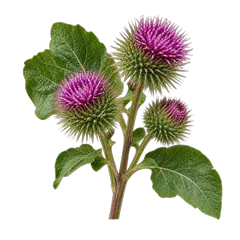
A biennial plant in the daisy family whose root is eaten in East Asia and has been used in folk medicine as a "blood purifier" and for skin conditions.
What is the plant
Burdock, or greater burdock (Arctium lappa), is a biennial plant in the daisy family (Asteraceae), native to the temperate regions of Europe and Asia. The plant can grow up to three meters tall, with large heart-shaped leaves and purple flowers clustered in globe-shaped heads. The bracts of the flower heads end in hooks that cling to clothing and animal fur, a feature that even inspired the invention of Velcro. Its main root is fleshy and long, and in East Asia it is eaten as a vegetable.
Plant parts used
- The root: the main part in research and in use as food and tea.
- The fruits (seeds): used in traditional Chinese medicine.
Traditional use
The 1854 American Eclectic medical guide described the root and seeds as diuretic, sweat-promoting and mildly laxative, and they were used for gout and kidney problems, with an emphasis on the need for prolonged use. In folk medicine burdock was used as a "blood purifier", for sore throats and colds, and topically for skin conditions. Other traditional uses include gout and lack of appetite. The root is also one of the ingredients of the well-known herbal blend Essiac. In East Asia the root is eaten as an everyday vegetable; in Japan it is known as gobo, and it is also commonly used as a tea.
What the research says
According to Memorial Sloan Kettering Cancer Center (MSKCC), laboratory and animal studies point to anti-inflammatory, antibacterial and blood sugar lowering activity, but these effects have not been confirmed in humans. A few small human studies have been carried out, for example a wrinkle cream, a tea for knee osteoarthritis and combination preparations, but they are limited and confirmatory studies are needed. There is no evidence that burdock treats cancer, infections or diabetes.
Safety and interactions
- Allergic skin reactions have been reported, as well as a single case of a severe allergic reaction after eating cooked burdock.
- People allergic to chrysanthemums and plants in the daisy family may also react to burdock.
- Not recommended during pregnancy, because the plant may stimulate the uterus.
- A case of liver injury was reported with a combined herbal tea containing burdock, and burdock teas contaminated with atropine have been found. It is important to choose a product from a reliable source.
- Tell your doctor about every herb and supplement you take.
Formulas with this plant