
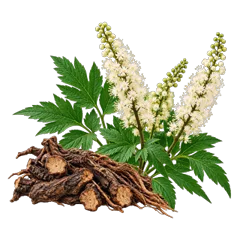
Black cohosh is a North American plant whose rhizome is used traditionally and has been studied for relief of menopausal symptoms, mainly hot flashes.
What is the plant
Black cohosh (Actaea racemosa, formerly also called Cimicifuga racemosa) is a perennial in the buttercup family (Ranunculaceae) that grows wild in North America. In English it is also known as black snakeroot and bugbane. It is important not to confuse it with blue cohosh, an entirely different plant with a different safety profile.
Plant parts used
Herbal preparations use the root and rhizome (the underground stem), usually as a dried extract.
Traditional use
Indigenous peoples of North America used the plant for kidney problems, sore throats and menstrual pain. In Germany it has been used in medicine since the late 19th century. Today it is best known as a supplement to support menopausal symptoms, and it is also used for menstrual pain and premenstrual syndrome.
What the research says
Black cohosh is one of the most studied plants in the context of menopause. According to the US National Center for Complementary and Integrative Health (NCCIH), a 2023 review of 22 studies found that extracts of the plant, alone or combined with other herbs, may help with menopausal symptoms overall. Improvement was found in hot flashes, but not in anxiety or depressive symptoms.
The European Medicines Agency (EMA) has recognized the rhizome as a well-established use (well-established use) for relief of menopausal symptoms such as hot flashes and excessive sweating, based on about 20 clinical studies involving more than 6,000 women. According to the MSKCC cancer center the picture is mixed: some trials support a benefit and others do not, and one meta-analysis found that an isopropanolic extract of the plant had an effect similar to low-dose transdermal estradiol. For other uses, such as menstrual pain or premenstrual syndrome, there is not yet enough reliable evidence.
Safety and interactions
- In studies, the plant was taken safely for up to one year and was generally well tolerated.
- Rare cases of liver injury have been reported, some serious, although it has not been proven that the plant caused them. Stop using it and see a doctor if you develop fatigue, loss of appetite, yellowing of the skin or eyes, upper abdominal pain or dark urine.
- The EMA recommends use by adult women only, and for no more than six months without consulting a doctor.
- It may not be safe during pregnancy and breastfeeding, and it is unclear whether it is safe for women with hormone-sensitive conditions such as breast or uterine cancer.
- Reported side effects, mainly at high doses: stomach discomfort, nausea, rash, dizziness and headache.
- Interactions are possible with tamoxifen, certain chemotherapy drugs and drugs metabolized by the CYP3A4 enzyme, although the clinical significance has not been proven.
- Before using it alongside regular medications, it is advisable to consult a doctor or pharmacist.
Sources
Formulas with this plant