
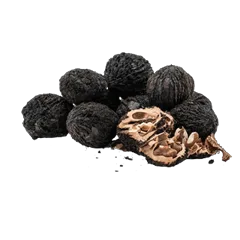
Black walnut is a North American tree whose green fruit hull is rich in tannins and juglone, and has traditionally been used against intestinal worms and fungal skin infections.
What is the plant
Black walnut (Juglans nigra) is a tall deciduous tree in the walnut family (Juglandaceae), native to central and eastern North America. The tree usually reaches about 25 meters in height, with a straight trunk, dark furrowed bark and long pinnate leaves. Its fruit is a nut wrapped in a thick green outer husk, which turns dark as it ripens. The tree releases the substance juglone, which inhibits other plants around it.
Plant parts used
Supplements mainly use the outer husk of the fruit (the green "hull"), which is rich in tannins and juglone.
Traditional use
In folk medicine, the husk of the unripe nut was used against intestinal worms and parasites, as a mouth gargle, applied to wounds and for fungal skin infections, and also as a hair dye. Its tannins are considered astringent, meaning they "tighten" and dry tissues and secretions.
What the research says
Human research is very sparse. The Natural Medicines database (via RxList) rates the evidence as "insufficient to rate" for all uses, including intestinal worms, gargling and skin sores. Laboratory studies have found antimicrobial and antitumor activity for juglone, but no studies have confirmed this in humans. The use of black walnut therefore rests mainly on tradition.
Safety and interactions
- Taken by mouth: in the short term it is classified as "possibly safe" for most people, although the possible side effects are not well known.
- Applied to the skin: classified as "possibly unsafe", because of juglone, which may irritate the skin. Daily use has been linked to a risk of lip and tongue cancer.
- Medications: the tannins may bind to medications in the digestive tract and reduce their absorption. It is advisable to take black walnut at least one hour after oral medications.
- Pregnancy and breastfeeding: avoid.
- Nut allergy: people with tree nut allergies should be careful.
In summary: black walnut is a plant with a long folk tradition, mainly for parasites and the skin, but research support for it is scant. It is advisable to use it for short periods, to separate it from taking medications and to avoid prolonged application to the skin.
Formulas with this plant