
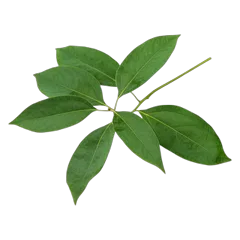
Camphor is an aromatic substance derived from the camphor tree of the laurel family, used mainly in skin preparations for its cooling sensation and itch relief.
What is the plant
The camphor tree (Cinnamomum camphora, now also classified as Camphora officinarum) is an evergreen tree in the laurel family (Lauraceae), native to Japan, Korea, Taiwan and the Ryukyu Islands, and it has spread to many regions of the world. The tree reaches 20 to 30 meters in height, its leaves are glossy and waxy and give off a camphor scent when crushed, and in spring it blooms with small, fragrant white flowers.
Plant parts used
Camphor is traditionally obtained from the wood by steam distillation, during which camphor crystallizes from the vapor. The wood and leaves are also distilled to produce essential oils. Today most commercial camphor is produced synthetically from turpentine oil.
Traditional use
Camphor has been used for generations as a medicinal substance, a spice, an ingredient in incense and an insect repellent. In medicine it is used mainly applied to the skin as a pain reliever, to relieve itching and as a local counterirritant (counterirritant), as well as in vapor preparations for cough.
What the research says
A study published in the Journal of Neuroscience (2005) showed that camphor activates the ion channels TRPV1 and TRPV3 in the skin, causing rapid and complete desensitization of TRPV1, and also inhibits the TRPA1 channel. The researchers suggest that these mechanisms may explain its pain-relieving effect. The cooling and soothing sensation on the skin therefore rests on a known mechanism, but controlled clinical studies of camphor as a treatment for specific skin conditions are few.
In skin preparations, camphor is usually one of several ingredients, and its main contribution is the cooling sensation and itch relief.
Safety and interactions
- Do not swallow. Camphor is toxic to the nervous system and is easily absorbed through the skin, mucous membranes, digestive tract and respiratory tract.
- Swallowing may cause digestive symptoms followed by seizures, respiratory arrest and coma. In children, a dose above 30 mg per kg is considered high, and seizures have been described in toddlers. There is no specific antidote.
- Keep out of the reach of children and take care when applying it to infants and toddlers, because camphor is also absorbed through the skin.
Formulas with this plant