
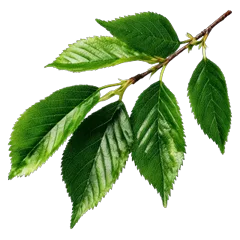
Slippery elm is a North American tree whose mucilage-rich inner bark is traditionally used to soothe the throat and the digestive system.
What is this plant
Slippery elm (Ulmus rubra, also called Ulmus fulva) is a tree of the elm family native to eastern North America, from North Dakota and Maine to northern Florida and eastern Texas. The tree usually reaches a height of 12 to 19 meters, its leaves are rough on top and velvety underneath, and its fruit is winged. It is also known as "red elm" or "Indian elm". Its English name, "slippery elm", comes from the slimy feel of the inner bark when chewed.
Parts used
Only the inner bark is used, not the whole bark. The inner bark is rich in mucilage, which on contact with water forms a gel that coats mucous membranes. It is used as a powder, tea, lozenges and ointments.
Traditional use
The inner bark was also used as food by Native peoples of North America, and it can be brewed into tea. Slippery elm has traditionally been used for digestive problems, sore throat, cough and skin ulcers, as well as for bronchitis and diarrhea. Its traditional action is described as soothing (demulcent) and mildly astringent.
What the research says
Research on slippery elm is very limited. According to MSKCC, a small pilot study on a formula that included slippery elm and other ingredients showed an improvement in bowel habits and symptoms in people with constipation-predominant irritable bowel syndrome, but the result cannot be attributed to slippery elm alone. Human data on cough, bronchitis, diarrhea and skin wounds are lacking. Laboratory studies point to antioxidant activity. The Natural Medicines database notes that there is no good scientific evidence for these uses.
Safety and interactions
- Taking it by mouth is considered likely safe for most people.
- Drug absorption: The mucilage may reduce the absorption of medications taken by mouth. It is advisable to take slippery elm at least an hour after medications.
- Use on the skin may cause an allergic reaction or irritation.
- As a precaution, it is advisable to avoid it during pregnancy and breastfeeding, due to a lack of reliable information.