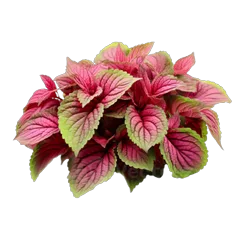
A perennial in the mint family from India and Nepal whose roots contain forskolin, used in Ayurvedic medicine and Asian traditions for a variety of conditions.
What is the plant
Coleus forskohlii (Coleus forskohlii, also called Plectranthus barbatus) is a perennial in the Lamiaceae family, the mint family. It grows wild on mountain slopes in Nepal, India and Thailand, and has thickened, tuber-like roots.
Plant parts used
The roots are used, and from them forskolin is extracted, a diterpene first isolated in 1974. This is the only species known to contain significant amounts of the compound. Forskolin activates the enzyme adenylate cyclase and raises levels of the molecule cAMP in cells, which is why it is widely used as a laboratory research tool. In laboratory and animal studies it was found to promote fat breakdown in cells, which is the reason for interest in it as a supplement.
Traditional use
In traditional Asian medicine and Ayurveda the plant was used for skin rashes, asthma and bronchitis, insomnia and angina, as well as for conditions of the digestive, respiratory, urinary and nervous systems.
What the research says
The evidence for the whole plant is considered weak, and most controlled studies tested isolated forskolin. MSKCC notes that very few clinical trials have been conducted and that studies proving efficacy and safety for the traditional uses are lacking.
- In a randomized double-blind trial of 30 overweight adults, combining the plant extract with a low-calorie diet for 12 weeks did not lead to weight loss beyond placebo, but a decrease in insulin levels and insulin resistance was measured. This was a small, short study.
- There are preliminary signs regarding forskolin in asthma and in eye drops for glaucoma, but further research is needed.
Safety and interactions
- The plant's safety has not been fully studied. In the clinical trial, mild digestive effects such as loose stools were reported, which resolved on their own.
- Take care when combining it with blood pressure lowering drugs and blood thinners, and use it only under a doctor's supervision.
- Safety has not been established in pregnancy, breastfeeding, young children and severe liver or kidney disease.
- In Italy, poisonings were reported that resulted from contamination of products with similar plants from the nightshade family, so it is important to choose a reliable source.
Sources
Formulas with this plant