
A thorny acacia tree from Africa's Sahel region that produces gum arabic, a soluble dietary fiber studied mainly as a prebiotic and as support for metabolic markers.
What is the plant
Gum acacia (Acacia senegal, currently also named Senegalia senegal) is a small, thorny tree in the legume family (Fabaceae). It grows in the arid and semi-arid regions of sub-Saharan Africa, especially the Sahel, and in parts of the Arabian Peninsula. It usually reaches 2 to 6 meters in height, with gray, curved thorns, creamy white flowers and thin, flat pods.
Plant parts used
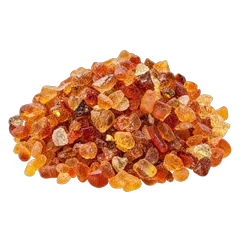
The material used is gum arabic: a resin that exudes from cuts in the branches and hardens on contact with air. Most production comes from Sudan, Chad and Nigeria. Chemically, it is a polysaccharide and protein complex (arabinogalactan protein) with magnesium, calcium and potassium salts. The gum is not digested in the small intestine and is fermented in the colon, where it is broken down mainly into short-chain fatty acids.
Traditional use
In sub-Saharan Africa, gum arabic is a long-standing home remedy and is also used for oral hygiene. In the food industry it has been used for many years as a stabilizer and thickener.
What the research says
A 2023 systematic review included 29 human clinical trials, ranging from about 10 to 189 participants. Some of the trials reported:
- Improvements in blood lipid markers, obesity markers and satiety, although results on blood sugar were conflicting.
- Reductions in kidney function markers and inflammatory markers in some studies of kidney patients.
- Less plaque and gum inflammation in oral health studies.
- A prebiotic effect, meaning it feeds beneficial gut bacteria.
The researchers themselves note that most trials were small and short, that their quality was not systematically assessed and that doses varied. These are therefore preliminary findings, not proof of effectiveness.
Safety and interactions
Gum arabic is considered safe as a food additive. Some trials reported bloating, gas and bowel sounds. The review also noted that taking it together with the antibiotic amoxicillin lowered the drug's peak blood concentration, so it is advisable to space out the timing and to consult a doctor or pharmacist if you take regular medications.